

Artistic, Athletic, and Spiritual Practices Are Not “Hobbies”
There are a few words I never use, and one of them is “hobby.” To my ear, it trivializes anything one might want to do that doesn’t churn out money or fame. I prefer the old fashioned terms for non-monetized activities: in Italian, a dilettante is one who takes delight in doing some particular thing. In French, similarly, the amateur is the one who loves to practice it. If a vocation is a “calling” to the clergy or the carpenter’s bench, an avocation is something outside one’s main pursuit that might nevertheless run parallel to it in skill or passion.
Rather than ask about someone’s “hobbies,” I’ll ask, “what do you enjoy?” More narrow expressions include “is there an art form that you practice?” or “Do you have a spiritual practice of some kind?” or “Are there any regularly occurring things you do outside your job?” It isn’t always more meaning that we’re after; sometimes it’s just physical exercise—though a closer look may show that this, too, means something to you: like self-care, gratitude for the body, esteem for delayed gratification, and so on.
People sometimes present with a form of stuckness where they don’t want to do anything—or they think they don’t—yet they yearn to want to. That’s a lot of internal conflict, and it’s often sustained by a sort of perfectionism that’s fixated on authenticity: unless I’m 100% certain that this (whatever it is) is exactly what I should be doing, I don’t want to do it. Otherwise I risk being an imposter, or boring myself with something I turn out not to like. This is a ploy of deferral, a fearful reluctance to exit the womb of one’s own apartment and enter the world. The fear is disguised as lethargy or dissociation, often into the rectangular black hole on whose screen you might be reading this right now.
The way out is to stop emphasizing the need for a perfect choice, and start emphasizing the need to choose. Seize upon something to try, and try it—rather than puzzling any further on exactly what might be the best possible use of your time outside of your job.
On several occasions in my life, especially when I was younger than 30, I hit upon an irrational scheme or project and followed it through because I knew it would get me somewhere, and I didn’t like where I was. For example, I learned Ancient Greek at the Latin-Greek Institute in the Summer of 1992 when I was 24. Two years later, I needed a scholarly writing project, and I had nothing to go on; grad school had wound down, and nobody was going to give me assignments from above anymore.
My favorite thing was (and is) blank verse in English, so I decided to translate an Athenian tragedy, even though I knew there were already hundreds of such translations. I needed to exercise the language skills I had learned, so they wouldn’t fade. I wanted to push myself to explore what Sophocles had achieved, and what he was trying to tell us. And I wanted an excuse to shape some lines of English poetry, without having to invent a plot. So I more or less arbitrarily chose Oedipus—traditionally known as Oedipus Tyrannus (in Greek) or Oedipus Rex (Latin), or Oedipus the Tyrant (English).
More randomly, I chose to do the whole thing on a mechanical typewriter I had bought off the street for $20, from somebody on 2nd Avenue and St. Mark’s Place in the East Village, near where I was living (on East 11th Street between 1st Ave and Avenue A). It was a clunky little Olivetti Littera 32, made of steel and coated with light green paint. I banged away at it all that Summer of 1994, and into the Fall. When it was done, I tried to place it with a theater or a publisher, and about twenty five rejections later, the dam broke. A British publisher, called Wordsworth Editions, said they would do the book—but only if I translated Antigone and Oedipus at Colonus, the other two plays in what’s called the Theban trilogy. I was thrilled; I agreed; I toiled at it for several more years, and the eventual book was published in 2004.
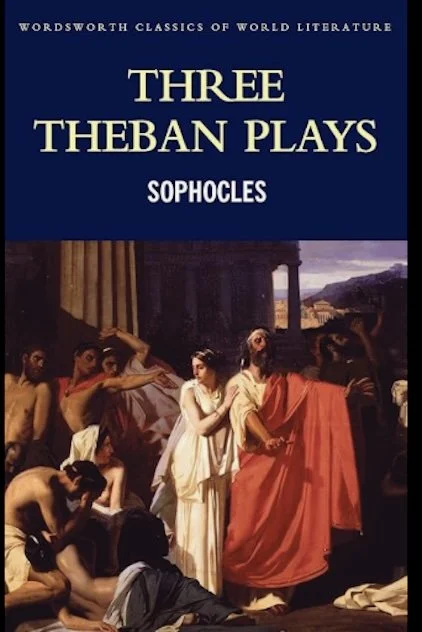
I had not dared to anticipate that happy outcome in 1994 when I started the project, ten years before. If I had known it would involve twenty-five rejections, and the further years of effort to render all three plays, I might not have done it. But I’m very glad I did, because it enriched my life in all sorts of ways that were equally unpredictable. I’ll explain—but the point is that doing something constructive despite its apparent irrationality can have unforeseeable benefits that keep unfolding for years to come.
In 2000, despite having almost no acting experience, I managed to play the small role of Eurydice in an all-male production of my Antigone translation with Chashama Workspace in New York City. More importantly, in Los Angeles in 2011, I played Teiresias in the Porters of Hellsgate production of my Oedipus the Tyrant, starring the superb Charles Pasternak, and directed by Thomas Bigley, who played Creon. That show got a rave review in the L.A. Weekly, from eminent theater critic Steven Leigh Morris.
Around that time, I began psychoanalytic training. It took eight years to complete, and taught me plenty about the human psyche, clinical technique, Freud and his successors, and my own nature and personal history. It also taught me a lot about institutional behavior, marginalization, and group dynamics. There was a faction at the institute whose devotion to a particular psychoanalytic theoretician seemed to me excessive, even worshipful. Wilfred Bion (1897-1979) had lived and worked there in the last years of his life, some thirty years before I arrived. Some of his former students and patients were now running the place, and their passionate admiration for him sometimes seemed to compete with what I saw as their obligations. It wasn’t always pretty, and I found my position increasingly challenging.
One of Bion’s papers from 1958 was pivotal in legitimizing most of what became his clinical approach. His disciples still swore by the thing, but the more closely I read and reread it, the more glaringly clear it became that it was based on an indefensible misreading of Sophocles’ Oedipus. My deep familiarity with the original Greek of that marvelous tragic drama was the perfect equipment with which to challenge Bion’s paper, and maybe even turn an instrument for the enforcement of intellectual conformity into a harmless museum specimen.
So I poured the energy of that struggle into the new project of explaining to the larger scholarly world just where it was that Bion had gone wrong. Eventually I submitted the results to the major journal of the psychoanalytic field. The editors were remarkably kind to me, devoting more hours to the improvement of the piece than I could have expected (apparently, I was not the only person ever to have felt some frustration about the same issue). Not only was the finished paper published, it won a prize, complete with a small cash award and a certificate that hangs on the wall in my office.
The point of this rambling anecdotal disclosure is that I only had those wonderful experiences because of a wildly irrational undertaking I threw myself into in my twenties, on a whim. It was illogical to translate Sophocles’ most famous play when hundreds of other people had already done so. And it was absurd to hold myself to the arbitrary scheme of creating a typescript on a mechanical typewriter (I still have it). But the weird combination of humility (“I know this may seem pointless”) and daring (“but I’m doing it anyway”) bore eventual fruit that could not have been grown and harvested by more rational means.
This reminds me of President Kennedy’s summoning of the nation to the Moon launch: “We choose to go to the moon in this decade and do the other things, not because they are easy, but because they are hard.” That speech at Rice University was not the height of his eloquence, but the point stands. Visiting that celestial rock was a massive achievement of engineering, insight, and courage, marshaling the collaborative efforts of thousands of people. Its unforeseen benefits affected medicine, transportation, communications, materials science, and more.
The part of each of us that calculates rational cost-benefit analyses is a crucial voice in a larger inner chorus. But it should not always be the final authority deciding where we go forward and where we refrain.
It is as if Life itself were a person, to whom we stand in a mysterious relationship, one that benefits from good faith more than from thoroughgoing prudence and obsessive efficiency.
So let yourself go and do something creative or edifying, without insisting on the certainty that it must be the best choice possible. Make a mark, then another. It was wise advice they gave in kindergarten at fingerpainting time: Just get in there and smear…